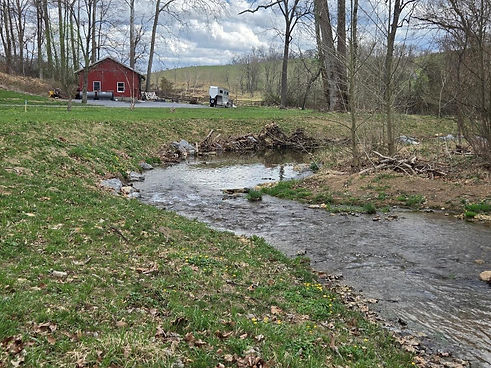
Millender Mill
This project involved the restoration of 2,300 linear feet of the mainstem of Piney Run in Baltimore County, along with 5.6 acres of riparian forest buffer.
The project was funded by grants awarded to The Land Preservation Trust (LPT). Design and permitting was funded by a grant from Baltimore County, and construction was funded by grants from the Maryland Department of Natural Resources Chesapeake and Atlantic Coastal Bays Trust Fund. Working under an existing Memorandum of Agreement with LPT, Watershed Environmental LLC served as the lead on all aspects of the design, permitting and implementation of this project. In collaboration with team partners Confluence Consulting (design engineering) and 3DX River Restoration (construction), Watershed Environmental completed this project in April 2025.
This project was funded completely or in part by Maryland's Chesapeake & Atlantic Coastal Bays Trust Fund. For more information, visit http://dnr.maryland.gov/ccs/Pages/funding/trust-fund.aspx


Before
Prior to implementation of the project, the reach of Piney Run comprising the project had been heavily impacted by historic agricultural practices on-site and within the watershed, as well as significant development and increased imperviousness in the stream's headwaters. The stream within the project reach was highly incised with high bed and bank shear. Additionally, a large section of the project reach had been straightened in the mid-1900’s.
After
The stream restoration utilized wood imported to the site for stabilization structures and maximized retention of existing trees along the stream corridor, resulting in both a high level of channel stability and dramatic increase in stream habitat. During construction, trout and other fish were re-located outside of the work area. The section of project reach previously straightened was restored to a natural alignment approximating its historic route. Relocation of the straightened channel necessitated the design and installation of a new driveway bridge to access the site, which was funded by the landowner. Live-staking and planting of trees and shrubs using native riparian species was installed along the restored channel to provide long-term stability and increased shading of the cold-water resource. The project has successfully withstood numerous significant storm/flood events since construction with no loss of stability or function.